
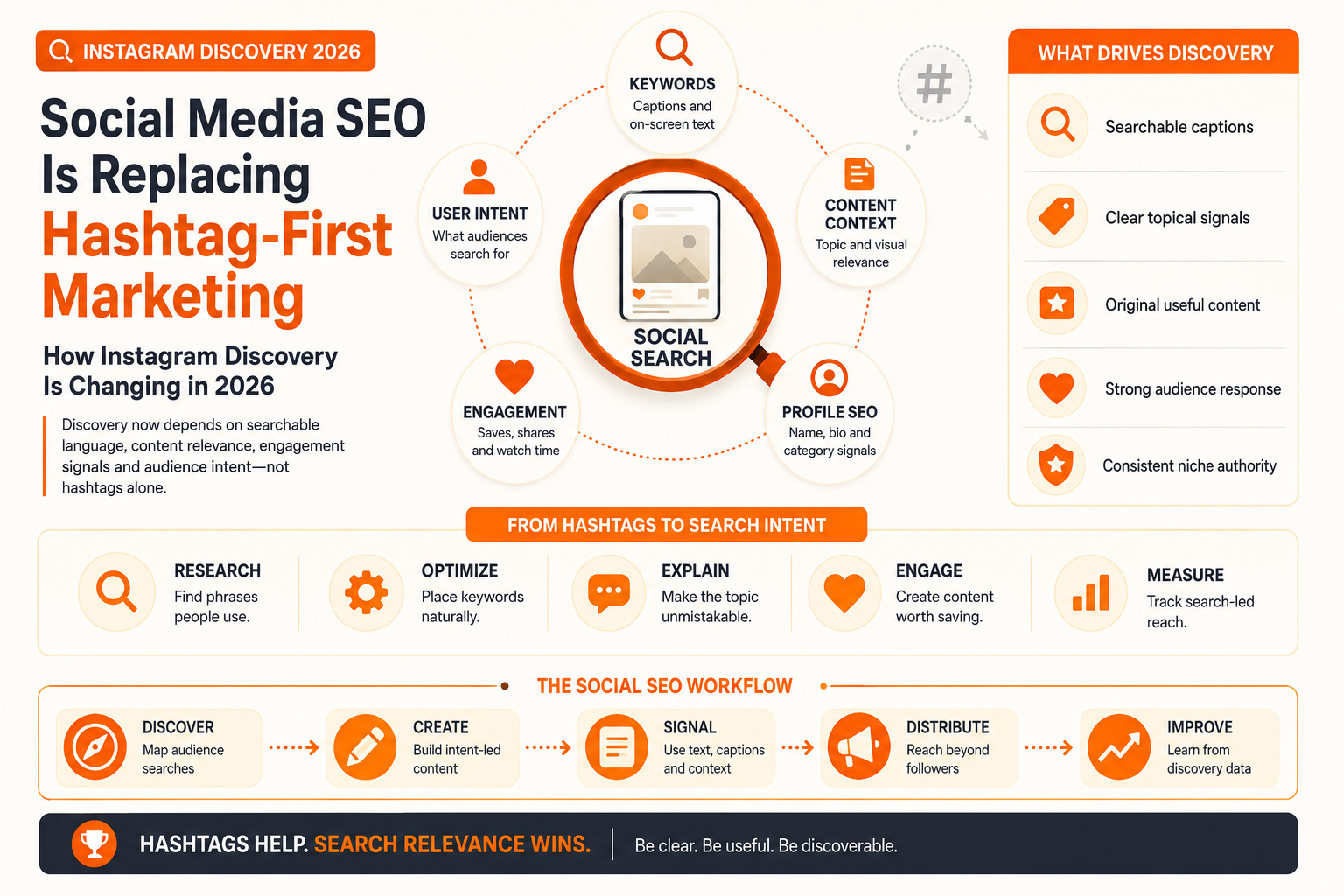
Instagram discovery is moving beyond traditional hashtag strategies. In 2026, social media SEO is becoming essential for brands and creators seeking greater visibility. Keywords, search intent, captions, Reels, profile optimization, on-screen text, and relevant hashtags can work together to help Instagram understand and surface content. This guide explains the changing Instagram SEO landscape, why hashtags are becoming secondary, and how businesses can create searchable, relevant content that reaches users beyond their existing followers.
Instagram discovery is changing, and hashtags are no longer carrying the weight they once did.
For years, adding a long list of hashtags was a standard Instagram growth tactic. Creators searched for popular tags, brands built hashtag sets, and marketers tried to reach new audiences through hashtag feeds.
In 2026, the smarter approach is broader: make your content easy for Instagram to understand and easy for users to find.
That is where social media SEO comes in.
What Is Social Media SEO?
Social media SEO means optimizing your social content and profile around the topics, phrases, and questions your audience is searching for.
On Instagram, this can include:
- Captions
- Keywords
- Profile name and bio
- Reel titles and descriptions
- On-screen text
- Spoken content
- Alt text
- Relevant hashtags
- Content relevance and engagement
The key change is that Instagram can use more than hashtags to understand what a post is about.
A post containing:
“5 beginner-friendly home workouts without gym equipment”
provides considerably more context than:
#fitness #workout #gym #fitnessmotivation
The first tells both the audience and the platform exactly what the content covers.
Hashtags Still Matter—but Their Role Is Changing
It would be too simplistic to say that hashtags are dead.
They can still help categorize content and reinforce its topic. The difference is that hashtags should no longer be treated as the entire discovery strategy.
Instead of asking:
“How many hashtags should I use?”
marketers should ask:
“Are the hashtags I use genuinely relevant to this content?”
A few closely related hashtags can support a well-optimized post. They should complement the content rather than compensate for a vague caption.
Keywords Are Becoming More Important
Search behavior is changing across social platforms.
People increasingly use Instagram to find:
- Products
- Restaurants
- Travel ideas
- Tutorials
- Fitness advice
- Beauty recommendations
- Local businesses
- Marketing tips
- Services
That means content should be created around search intent, not just trends.
For example, instead of creating a generic post titled:
“Instagram Tips”
a business could create:
“Instagram SEO Tips for Small Businesses in 2026”
The second topic is more specific and gives Instagram a clearer understanding of the content.
Captions Are Becoming Searchable Content
Captions should no longer be treated as an afterthought.
A useful caption naturally explains:
- What the post is about
- Who it is for
- What problem it solves
- What the reader can learn
You don’t need to repeat the same keyword throughout the caption.
Natural language is more useful.
For example:
“Trying to get more local customers through Instagram? These three Instagram SEO techniques can help a small business improve its visibility when potential customers search for relevant products or services.”
This provides much more context than a caption consisting mainly of emojis and hashtags.
Reels Need More Than a Good Hook
Reels remain a major discovery format, so SEO should be considered when creating them.
Think about the different places where a topic can appear:
- What you say in the video
- Text displayed on screen
- The caption
- The Reel’s topic
- Relevant hashtags
For example, if your Reel is about “Instagram SEO for restaurants,” make that subject obvious instead of relying on a vague title such as “3 marketing tips.”
The clearer the topic, the easier it is for users to understand what they are about to watch.
Your Profile Is Part of Your SEO Strategy
Social SEO doesn’t start when you publish a post.
Your profile also tells Instagram and potential followers what your account is about.
A business profile should make its:
- Industry
- Services
- Location, where relevant
- Target audience
- Main area of expertise
easy to understand.
Compare:
“Helping brands grow online 🚀”
with:
“Digital marketing agency helping small businesses with SEO, content marketing and social media.”
The second communicates a much clearer subject.
Long-Tail Keywords Can Help
Broad terms are often difficult to target because they cover huge topics.
Instead of focusing only on:
“digital marketing”
consider topics such as:
“digital marketing for small businesses”
or:
“Instagram marketing tips for local businesses”
Specific phrases help you create content for a more clearly defined audience.
This is one of the biggest lessons traditional SEO can bring to social media: specific intent is often more useful than broad popularity.
Social SEO Is Not Just About Keywords
There is a danger in taking SEO too literally.
Adding keywords everywhere won’t automatically make content successful.
Instagram is still a social platform. People watch, share, save, comment and follow accounts because the content is useful, entertaining or interesting.
Therefore, social SEO should combine:
Discoverability + relevance + quality + engagement
A perfectly optimised caption cannot save content that nobody wants to consume.
The New Instagram Content Strategy
The old process was often:
Create → Add hashtags → Publish
A stronger 2026 process is:
Research → Identify search intent → Create useful content → Optimise → Publish → Measure
Before creating a post, ask:
- What topic am I covering?
- What might my audience search for?
- Does my caption clearly explain the topic?
- Is the subject obvious in my Reel?
- Is my profile relevant to the topic?
- Are my hashtags genuinely useful?
These questions are more valuable than simply collecting another list of trending hashtags.
What This Means for Businesses
For businesses, social SEO creates an opportunity to reach people who don’t already follow them.
A restaurant can create content around local dining searches.
A real estate company can answer questions about buying property.
A software company can explain common problems its product solves.
An accountant can publish answers to small-business finance questions.
Instead of creating content simply because it is Tuesday and something needs to be posted, businesses can build content around real customer questions and search behavior.
That makes social media content more useful and potentially more discoverable.
Hashtags Are Not Disappearing—They Are Becoming Secondary
The biggest misconception about Instagram SEO is that the platform is moving from “hashtags” to “keywords” overnight.
The reality is more nuanced.
Instagram discovery is becoming increasingly context-driven.
Hashtags can still provide context, but they are only one part of the picture.
Captions, profiles, video content, on-screen text, audience behavior, and the overall topic of an account can all contribute to how content is understood and discovered.
Final Takeaway
The Instagram SEO strategy of 2026 is less about finding the perfect collection of hashtags and more about making your content clearly relevant to what people are searching for.
Use keywords naturally. Write useful captions. Optimize your profile. Make Reel topics obvious. Use relevant hashtags without depending on them.
The question has changed from:
“Which hashtags should I use?”
to:
“What is my audience looking for, and does my content clearly answer it?”
That is the real shift from hashtag-focused marketing to social media SEO.